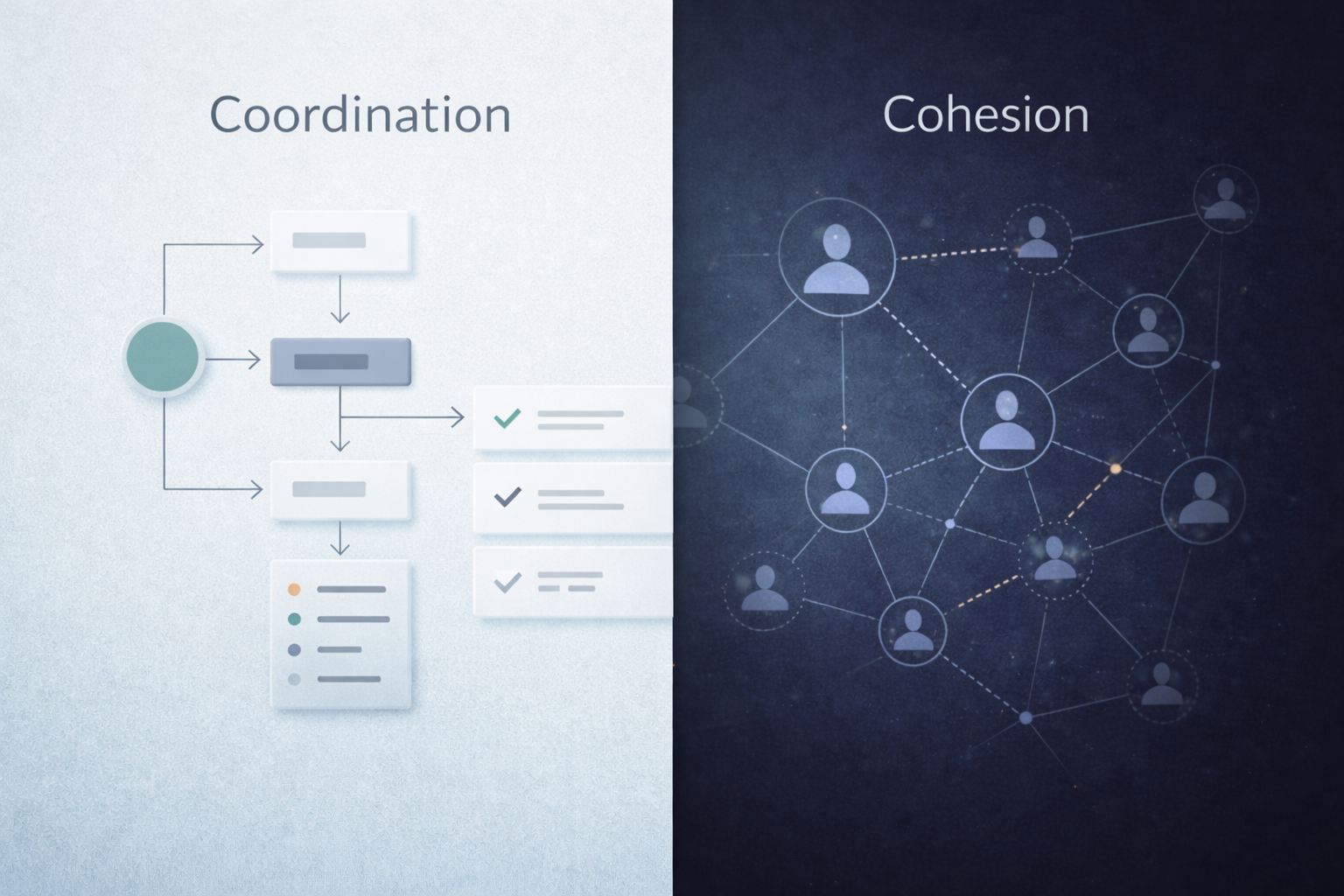
Distributed teams today are more organized than ever.
They operate with:
- structured documentation
- project management systems
- asynchronous workflows
- detailed planning rituals
These systems allow companies to coordinate work efficiently across time zones. And coordination is important. Without it, remote teams quickly become chaotic.
But coordination alone does not create strong culture. Many distributed teams are highly coordinated yet surprisingly fragile. The reason lies in a misunderstanding between two concepts:
Coordination and cohesion.
What Coordination Actually Means
Coordination refers to how effectively a team organizes work. Clear tasks. Defined responsibilities. Efficient processes. Tools like Notion, Slack, Asana, and Jira make coordination easier than ever.
With the right systems, teams can operate smoothly even without frequent live interaction. Projects move forward. Deadlines are met. Communication stays structured. From a leadership perspective, everything appears under control.
But coordination focuses primarily on tasks. It does not automatically create emotional connection between the people performing them.
What Cohesion Actually Means
Cohesion is different.
Cohesion refers to the strength of the relationships and shared identity inside a team. It determines whether people feel responsible for the collective outcome, not just their individual tasks. Cohesive teams tend to show:
- healthy debate
- shared ownership
- mutual support
- strong psychological safety
When cohesion is high, team members challenge ideas openly and collaborate beyond their formal roles. When cohesion weakens, communication becomes more transactional. People complete assignments but invest less in the broader mission.
Why Remote Teams Often Have Coordination Without Cohesion
Remote environments naturally prioritize structure. Without clear systems, distributed work quickly becomes confusing. So leaders invest heavily in tools and processes. Over time, coordination becomes very strong. But something subtle begins to disappear. Spontaneous collaboration.
In physical offices, many moments of cohesion form organically. Quick discussions. Unexpected brainstorming. Informal debates. These interactions create shared experiences.
Distributed teams rarely encounter these moments naturally. Instead, interactions become scheduled and purpose-driven. Weekly standups. Sprint reviews. Planning sessions. While these meetings maintain coordination, they rarely strengthen cohesion.
The Consequences of Weak Cohesion
When cohesion declines, the effects appear gradually. Debate becomes less frequent. Risk-taking decreases. People contribute fewer ideas. The team remains operationally effective. But something important is missing.
Collective ownership.
Team members begin focusing primarily on their assigned responsibilities rather than the overall mission. Innovation slows. Problem-solving becomes more isolated. And leaders begin noticing a lack of energy in discussions. None of these changes immediately affect output. Which makes the problem easy to overlook.
Why Cohesion Requires Shared Experience
Strong teams are not built solely through communication. They are built through shared experience. Especially experiences that involve:
- mutual reliance
- time pressure
- collaborative problem-solving
- clearly defined roles
These moments create a sense of collective effort. They give teams stories, reference points, and trust. Without these experiences, remote teams remain coordinated but disconnected. The work continues, but the culture weakens.
The Leadership Shift
Leaders of distributed teams must recognize that systems alone cannot maintain culture. Documentation organizes work. Processes improve efficiency. But cohesion requires something more intentional.
It requires designing opportunities for teams to interact dynamically. Not just through updates and planning meetings, but through structured collaboration where team members must rely on each other in real time.
These experiences strengthen communication patterns and rebuild shared identity.
Final Thought
Coordination keeps work moving. Cohesion keeps teams invested. Both are necessary. But many remote organizations unknowingly optimize one while neglecting the other.
When cohesion fades, culture weakens quietly. And over time, that weakness affects innovation, retention, and leadership trust.
The strongest distributed teams understand that coordination is only the foundation. Sustainable culture is built through shared experiences that strengthen connection, trust, and collective ownership.
Because in remote environments, cohesion never happens by accident. It must be designed.