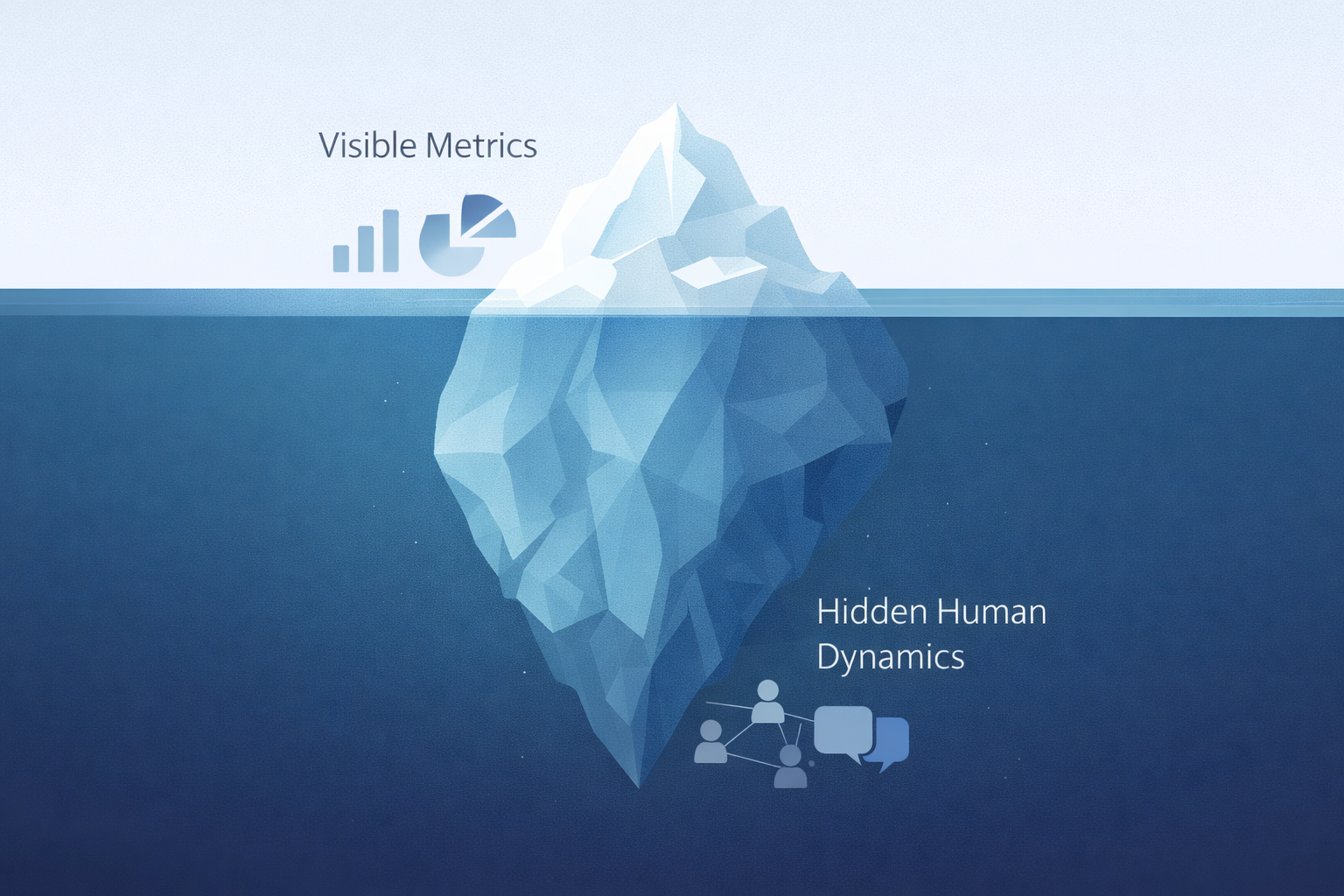
Remote teams rarely break in obvious ways. There’s no dramatic collapse. No moment where everything suddenly fails. Instead, something quieter happens.
Energy fades. Debate softens. Ownership weakens. And by the time leaders notice, the culture has already drifted.
For founders leading distributed teams, the challenge isn’t just operational. Many of the most damaging remote leadership blind spots are perceptual.
The biggest risks in remote leadership are often the ones founders don’t see.
Blind Spot #1: A Common Remote Leadership Blind Spot — Mistaking Calm for Stability
Many founders interpret calm meetings as a sign of alignment. No one is arguing. Decisions move quickly. Updates run smoothly.
It feels efficient.
But calm does not always mean healthy. In remote environments, calm often signals reduced emotional investment. When team members stop challenging ideas, it’s rarely because everything is perfect.
It’s often because people no longer feel responsible for shaping outcomes.
Disagreement is not dysfunction.
In high-performing teams, it’s a sign of engagement. When disagreement disappears, leaders should become curious — not comfortable.
Blind Spot #2: Overvaluing Coordination
Distributed teams are often extremely organized.
They have:
- Detailed documentation
- Structured standups
- Clear project tracking
- Asynchronous workflows
These systems create operational clarity.
But coordination is not the same as cohesion. A team can coordinate tasks effectively while feeling emotionally disconnected. When work becomes purely transactional, people focus on completion rather than contribution.
The team continues to function. But the collective identity weakens. And over time, that erosion affects initiative, creativity, and ownership.
Blind Spot #3: Assuming Productivity Reflects Engagement
One of the biggest remote leadership blind spots is equating output with investment. A team may still deliver. Deadlines may still be met. Projects may still move forward.
But performance alone does not reveal emotional commitment. Highly skilled professionals can remain productive even after disengaging from the broader mission.
What changes is not what they do. It’s how much they care. And that shift becomes visible first in communication patterns — not metrics.
Blind Spot #4: Waiting for Metrics to Signal Culture Problems
Founders often rely on measurable indicators to detect issues. Retention rates. Engagement surveys. Performance reviews.
These tools are useful, but they are reactive. They identify problems after they have already developed. By the time engagement scores decline, disengagement has been growing quietly for months.
Culture erosion is rarely sudden. It accumulates slowly through small behavioral changes. Shorter responses. Less initiative. Reduced curiosity. Less constructive disagreement.
Metrics eventually reflect these patterns — but they rarely detect them early.
Blind Spot #5: Underestimating the Importance of Shared Experience
In traditional offices, teams naturally accumulate shared moments. Lunch conversations. Hallway debates. Informal problem-solving.
These experiences build identity.
Distributed teams rarely have those spontaneous interactions. Instead, most interactions become structured and task-oriented. Weekly standups. Status updates. Planning sessions.
These formats keep work moving but do little to strengthen the emotional fabric of the team. Without intentional moments of shared challenge or collaboration, team identity weakens. And when identity weakens, drift begins.
What Strong Remote Leaders Do Differently
Leaders who recognize and correct these remote leadership blind spots understand that cohesion does not happen automatically. They treat culture as something that must be actively designed. This means creating environments where teams experience collaboration in more dynamic ways.
Not just through routine meetings, but through structured interaction that involves:
- Clear roles
- Real-time decision-making
- Mild pressure or stakes
- Shared responsibility for outcomes
These moments reveal how teams truly communicate. They also create shared reference points that strengthen trust and identity.
The Leadership Shift
Remote leadership requires a shift in perspective.
Instead of asking: “Is productivity stable?”
Leaders must ask: “Is emotional investment growing or fading?”
Instead of waiting for engagement scores to decline, leaders must observe communication patterns in real time. Because the earliest signs of culture drift are behavioral, not numerical. And those signals appear long before performance metrics change.
Final Thought
The most dangerous remote leadership blind spots in distributed teams are rarely visible. They unfold gradually. A little less debate. A little less ownership. A little less curiosity.
None of these changes trigger alarms. But together, they slowly reshape the culture. Founders who understand this don’t wait for obvious problems. They design environments that continuously strengthen connection, trust, and shared identity.
Because in distributed teams, cohesion is not maintained by accident.
It is built intentionally.