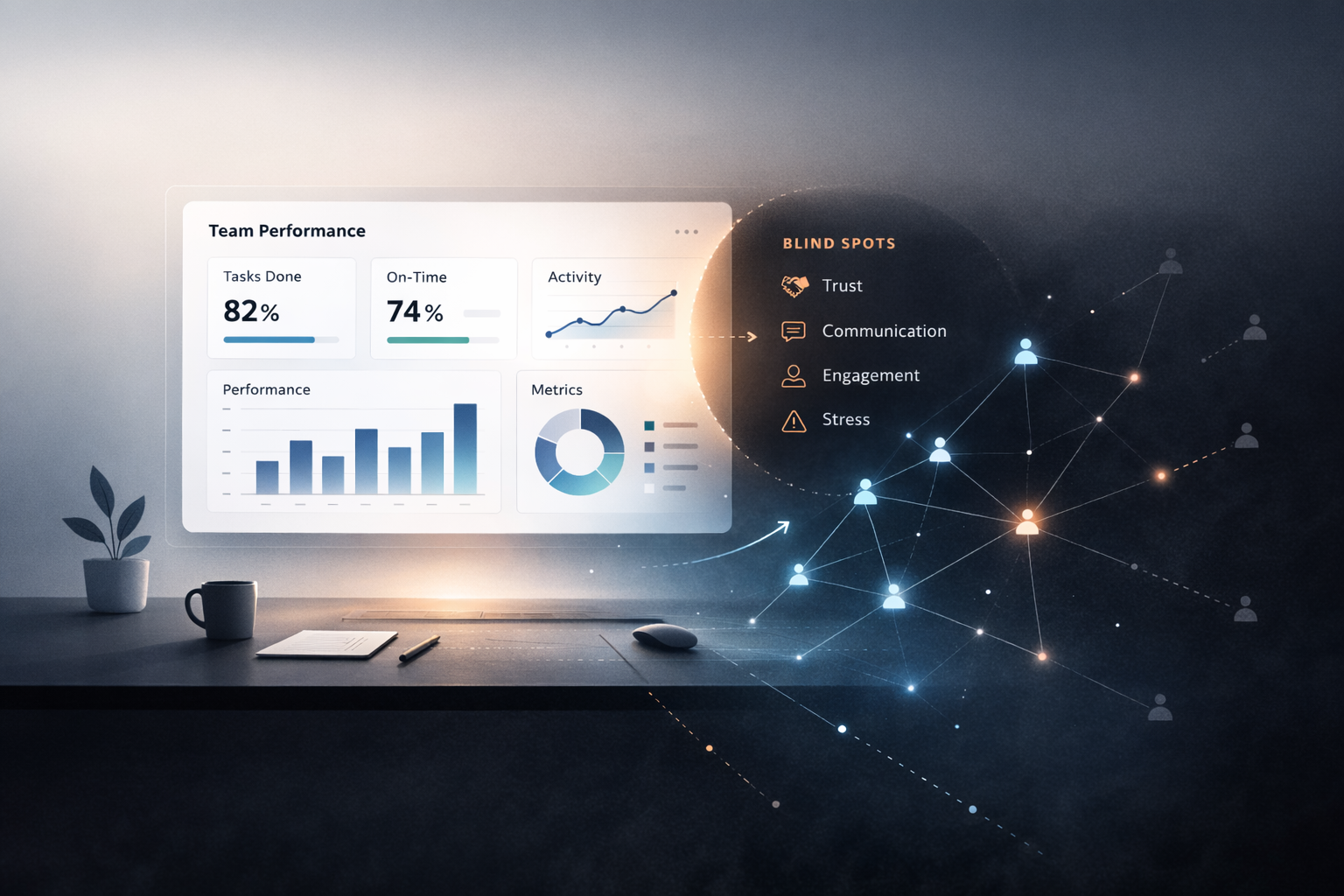
For many companies, engagement surveys are the primary tool used to monitor culture. Every quarter or twice a year, employees are asked how they feel about:
- their manager
- their workload
- communication
- company culture
The results are compiled into dashboards, analyzed by HR teams, and presented to leadership. These surveys can provide useful signals. But they also create a dangerous illusion:
The belief that culture problems can be detected early through metrics.
In reality, engagement surveys often reveal problems long after disengagement has already begun.
The Lagging Indicator Problem
Most engagement surveys measure how employees feel at a specific moment in time. But disengagement in remote teams rarely happens suddenly. It develops gradually. Small behavioral changes appear first:
- people contribute fewer ideas
- discussions become shorter
- debate decreases
- responses become transactional
None of these shifts immediately change survey scores. In fact, many employees continue to answer engagement surveys positively even while their emotional investment declines.
Why? Because disengagement often starts subtly and privately.
People adjust their expectations before they adjust their survey responses. By the time engagement scores decline, the drift has already progressed.
Emotional Withdrawal Is Hard to Measure
Remote work changes how emotional signals appear inside teams. In physical offices, leaders can often sense early shifts. Body language. Energy in conversations. Informal interactions.
In distributed environments, most communication happens through structured channels. Scheduled meetings. Written updates. Task-oriented discussions.
These formats are efficient, but they hide emotional nuance. A team member can appear fully engaged operationally while quietly withdrawing emotionally. They attend meetings. They complete tasks. They respond in Slack.
But they stop contributing ideas. They stop challenging assumptions. They stop taking initiative. And none of those behaviors show up clearly in engagement survey results.
Why High Performers Often Disengage First
One of the most surprising dynamics in remote teams is that high performers often disengage before anyone notices. Highly skilled professionals are capable of maintaining output even after emotional investment fades. They continue delivering work. But something changes internally.
Curiosity decreases. Energy drops. Ownership becomes narrower. Eventually, these employees leave — often without major warning signs. Exit interviews may reveal dissatisfaction.
But by then, the disengagement has been unfolding for months. Engagement surveys rarely capture these early shifts because the behaviors remain functional for a long time.
The Limits of Survey-Based Culture Monitoring
Engagement surveys are not useless. They can reveal patterns across teams. They can highlight areas of dissatisfaction. But they are reactive tools. They diagnose culture problems after they become visible. They do not prevent drift.
To understand early-stage disengagement, leaders must observe something more subtle than survey responses. They must observe communication dynamics.
The Signals That Appear First
Before engagement scores change, communication patterns begin to shift. Early signals often include:
- fewer spontaneous ideas
- reduced disagreement
- shorter discussions
- fewer cross-team interactions
- more passive agreement in meetings
These signals indicate declining emotional investment. But they are easy to miss when leaders focus primarily on quantitative indicators. Remote leadership requires attention to behavioral patterns, not just survey data.
Moving From Measurement to Design
Many companies focus heavily on measuring engagement. Fewer focus on designing environments that strengthen it. But engagement is not simply a sentiment. It is an outcome of experience.
Teams become more invested when they participate in meaningful collaboration. Especially collaboration that involves:
- shared responsibility
- real-time interaction
- clear roles
- mild stakes
These experiences create shared identity. Shared identity reinforces belonging. And belonging strengthens engagement far more effectively than surveys alone.
Final Thought
Engagement surveys tell leaders how employees feel after culture has shifted. They rarely show the earliest signs of disengagement.
In remote teams, those signals appear first in behavior. A little less debate. A little less curiosity. A little less ownership. These changes often happen quietly. But they are the earliest indicators of culture drift.
Leaders who want to sustain strong remote teams must look beyond surveys. They must design experiences that continuously reinforce connection, collaboration, and shared identity.
Because in distributed teams, engagement cannot simply be measured. It must be actively built.