Key Takeaways
- AI agents are built to coordinate — scheduling, routing, follow-ups, documentation — and they do it well across time zones without needing a live meeting.
- As agents absorb coordination work, the human role shifts toward understanding, judgment, and relationships.
- Remote and async work was never the fundamental problem. The coordination overhead was.
- When agents handle logistics, the real challenge becomes keeping teams connected as people, not just as workers.
- The future of remote work is not less human. It has to be more intentionally human.
I have worked remotely for years. And if I am being honest, a significant portion of that time went toward coordination that probably did not need me involved at all.
Status updates. Scheduling back-and-forths. Follow-up messages checking whether someone saw the last follow-up message. Meeting recaps summarising things everyone already knew.
This is the overhead that makes remote work feel draining. Not the actual work. The coordination layer around it.
Here is what I think is about to change that.
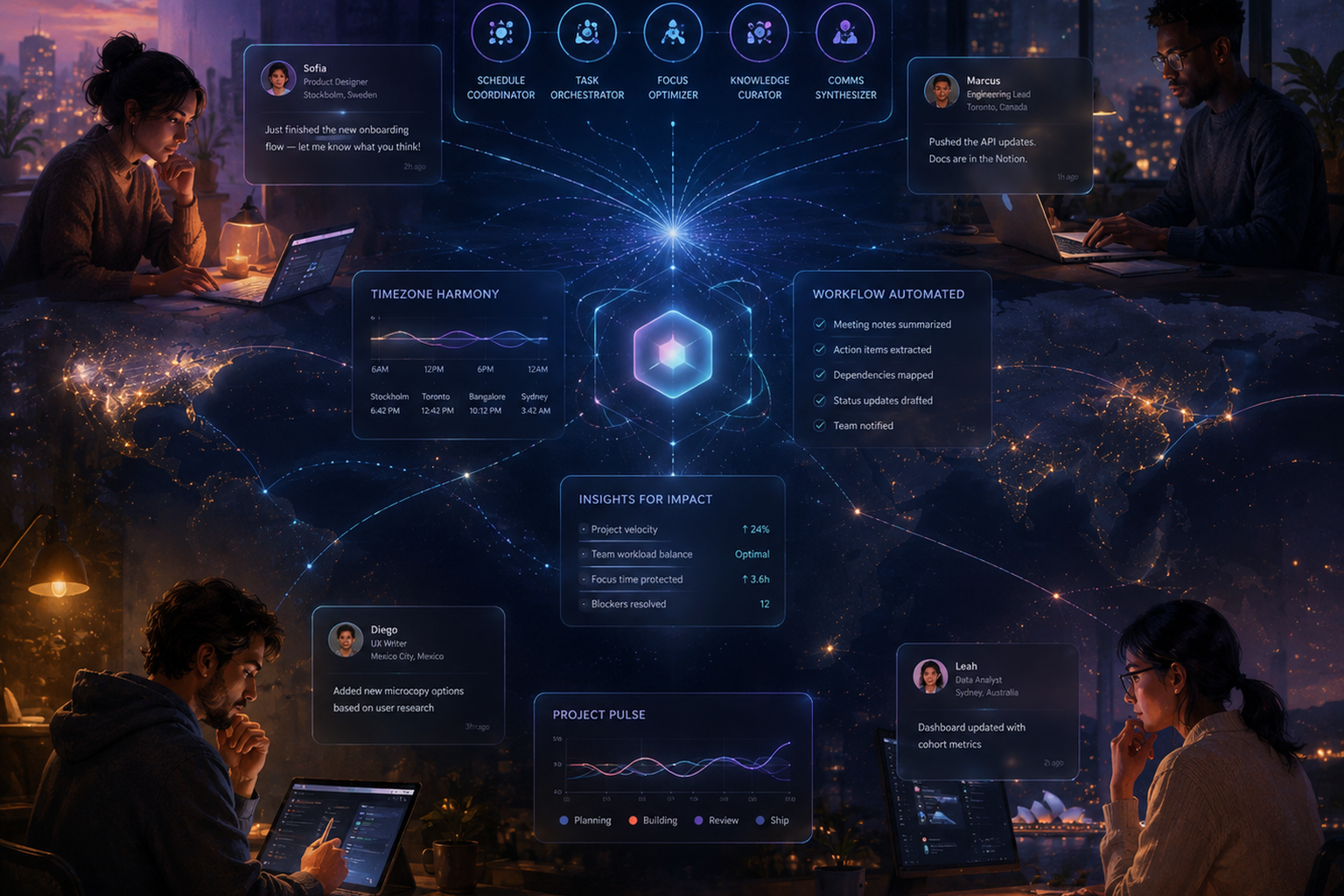
Coordination is exactly what AI agents are built for
AI agents are not just chatbots you type questions into. They are systems that take action, communicate with other agents, and complete multi-step tasks without a human involved at every stage.
What kinds of tasks? Scheduling across time zones. Routing work to the right person. Sending follow-ups. Updating project boards. Summarising long async threads so nobody has to read through 200 Slack messages to catch up.
Sound familiar? That is basically the entire coordination layer of every remote team I have ever been part of.
Agents are genuinely well-suited to this. They do not forget. They do not need a live meeting to hand something off. They work across time zones without complaining. Microsoft's 2026 Work Trend Index describes this moment as agents taking on execution while human agency expands. The question, as they put it, is whether organisations are built to capture that opportunity.
Most are not yet. But the direction is clear enough to start preparing now.
So what does that leave for humans?
Understanding.
When the coordination work is absorbed, what remains is the part that actually requires a person. Reading between the lines of what a client really needs. Deciding which tradeoff is worth making when the data pulls in two directions. Recognising when a team member is struggling before they say anything out loud.
These things require context, judgment, and trust. They cannot be delegated to an agent because they depend on actually knowing the people involved and understanding the situation beyond what is written down anywhere.
This is where remote and async work starts to make a different kind of sense.
The office was always built around coordination
Think about why offices exist in the first place. A lot of it is coordination. It is easier to hand something off when you can walk over. It is faster to get alignment when everyone is in the room. Hallway conversations move things forward without anyone scheduling a meeting.
But if agents handle that coordination layer, the structural argument for being co-located weakens significantly. You do not need to be in the same building to coordinate when your agents are doing that for you.
Research from the WFH Research project at Stanford shows that college-educated workers now do about 25% of their workdays from home. That number has stabilised rather than reversed. Remote and async work was always a strong fit for deep, focused, independent work. Now the coordination argument for being in the office is eroding too.
The challenge nobody is talking about yet
Here is where I think most of the conversation about AI agents misses something important.
When agents coordinate the work, who coordinates the people?
There is a difference between a team that functions well and a team that genuinely trusts each other. Coordination keeps projects moving. But cohesion — the feeling that you are working toward something together with people you actually care about — does not come from efficient task routing.
This is a distinction worth understanding deeply. The difference between coordination and cohesion in distributed teams is not subtle. A team can be highly coordinated and still feel completely disconnected.
I have sat in enough virtual meetings to know the difference between a team completing tasks and a team invested in each other. The second kind is rarer. And it does not form automatically, especially in remote environments where spontaneous human moments are already scarce.
Worth noting: the Remote Labor Index found that even the most advanced AI agents still perform near the floor on complex, real-world remote work projects. Agents are improving fast, but the judgment-heavy, context-dependent work remains firmly human. That gap is not closing as quickly as the headlines suggest.
If agents absorb coordination overhead, remote teams will have more room for meaningful interaction. But that room does not fill itself. It has to be designed deliberately. Without that intention, teams risk becoming more efficient and more disconnected at the same time.
What this means in practice
We are still early in the age of agents. Most teams are just starting to work out what these tools can actually do. But the direction is clear enough to act on now.
The remote teams that will thrive are not the ones that automate everything and assume the human side will take care of itself. They are the ones that use automation to cut the overhead, then deliberately invest the freed-up time into building real connections.
And real connection in distributed teams does not happen passively. As we explored in why shared experience is the missing layer in remote team culture, teams build trust through moments where they have to actually rely on each other — not through better scheduling tools.
That means creating shared experiences. Moments where your team has to rely on each other, communicate under pressure, and solve something together in real time. Not because the agent could not handle the scheduling, but because that is how people build trust.
That is also the thinking behind Stellar Bonds — a cooperative space mission where remote teams have to work together to keep things from falling apart. You cannot delegate that to an agent.
The logistics of remote work are becoming a solved problem. The human layer is not. That is the part worth focusing on now.
FAQ
What are AI agents in the context of remote work?
AI agents are software systems that can complete tasks, communicate with other systems, and take action without constant human input. In remote work, they handle coordination tasks like scheduling, task routing, follow-ups, and documentation updates.
Will AI agents replace remote workers?
Not the work that requires real judgment and understanding. Agents handle coordination well but still struggle with context-heavy, relationship-driven decisions. The Remote Labor Index found that even advanced agents perform near the floor on complex real-world remote projects.
How does async work benefit from AI agents?
Async work has always been strong for focused, independent tasks but difficult for coordination across time zones. Agents reduce that coordination overhead, making async workflows smoother without requiring everyone to be online simultaneously.
What is the biggest risk for remote teams in the age of agents?
Assuming that because coordination is handled, the human side will take care of itself. Connection and cohesion in remote teams require intentional design — see our post on coordination vs cohesion in distributed teams for a deeper look at why this matters.
How can remote teams build connections when agents handle coordination?
By investing the time that coordination used to consume into shared experiences that require real collaboration. Activities where team members rely on each other, communicate under pressure, and build genuine trust. Shared experience is the missing layer most remote teams overlook.
Sources